Panda CSS 2.0
We rewrote the Panda compiler in Rust. Same styling API, a new engine underneath, and the features that rewrite made possible.


Today we are releasing Panda CSS 2.0.
You write the same Panda you already know. The same css(), the same recipes and patterns, the same tokens, conditions, and JSX style props. What changed is the machine underneath: we replaced the compiler with a new engine written in Rust, and that rewrite opened up capabilities the old engine could not reach.
This is the largest change to Panda since we first shipped it, and almost none of it touches your code. Here's the short version:
- A new compiler engine written in Rust, on Oxc (opens in a new tab). Same
css(), recipes, tokens, and JSX props; identical CSS out. - 15–37× faster extraction, and watch-mode re-parsing on the order of 360× faster.
- staticCss builds about 85× faster, from 25.7 s to 0.3 s on a 29,000-rule config.
- ~99% fewer TypeScript type instantiations on your generated types, for a lighter editor and CI.
- Design systems you can publish:
panda libto author,designSystemto consume, with no re-extraction in the consuming app. - New in the box:
viewTransition(), mask and scrollbar utilities,@property-registered variables, a first-party ESLint plugin, a typography preset, and a rebuilt CLI. - ESM-only, needs Node 22 or newer. It ships as a beta today.
The rest of this post walks through why we rewrote the engine, what the new pipeline looks like, what it made faster, and the features that came out of it, then a full checklist for upgrading.
Why we rewrote the engine
Panda's original engine was TypeScript analysis running in Node. Extraction was built on ts-morph (opens in a new tab), a wrapper over the full TypeScript compiler, and constant values were folded with a JavaScript interpreter. That worked, and it shipped a lot of good software. But it carried costs that grew with your project, and it boxed us out of things we wanted to build.
TypeScript builds a whole-program graph. Panda doesn't need one. A type in TypeScript can be declared anywhere and merged across files, so the compiler has to hold the entire program in memory to answer a question about any part of it. ts-morph inherits that. Panda's actual question is much narrower: what value does this one style call receive? The old engine paid for the general answer anyway, on every build.
A JavaScript interpreter sat on the hot path. To resolve something like fontSize: sizes.lg * 2, v1 ran the expression through a JS evaluator at build time. It was correct, but interpreting JavaScript to compute a CSS value is a lot of work to repeat for every style in every file on every change.
The engine was Node-only. It couldn't run in a browser. The playground, the editor extension, and diagnostics each had to reimplement or approximate extraction instead of sharing the one the build uses. That's how the playground and the compiler drift apart.
Per-file callbacks were expensive. Hooks like the old matchTag ran a JavaScript function for every element in every file. Once the engine moved to Rust and the browser, a per-element JS callback crossing that boundary simply isn't an option.
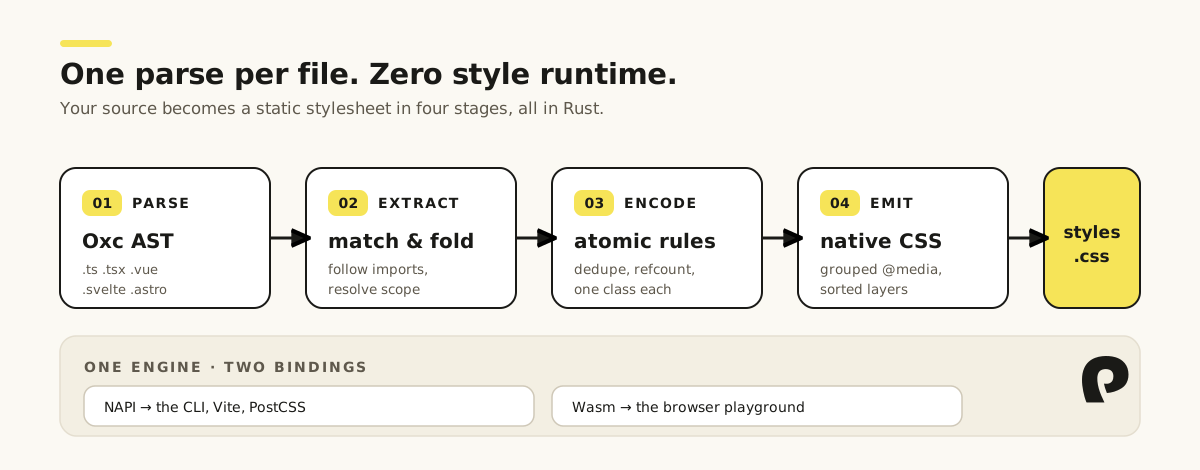
So we rebuilt the hot path in Rust on top of Oxc (opens in a new tab), a fast JavaScript toolchain written in Rust. One engine, wrapped by two thin bindings: a native binding for the CLI and bundlers, and a WebAssembly binding for the browser. Both run the identical code and produce identical CSS. Your panda.config.ts, your css() calls, your recipes: all the same. The machine that reads them is new.
Inside the new engine
The v2 engine is a one-way pipeline: extract → encode → emit. Source files flow in, atomic style rules accumulate, and a stylesheet comes out. Each stage is its own Rust crate that knows nothing about the stages around it. Here's what happens to your code on the way through.
One parse per file
In v1, several tools each parsed your files to answer their own question. In v2 a single Oxc parse produces one AST that feeds every step — collecting imports, matching them against your config, walking call sites, walking JSX, resolving identifiers. Imports, css() calls, and <styled.div> elements all read from the same parse and the same semantic pass.
That single pass has a fast exit built in. Before doing any real work, the engine collects the file's imports and matches them against your Panda entry points. If nothing in the file imports from styled-system (or wherever your Panda output lives), it stops right there — no identifier resolution, no visitor walks. On a real project most files are node_modules JavaScript that never touch Panda, and skipping them cheaply is a measurable part of why cold builds got faster.
The engine builds itself once
createCompiler(config) returns a long-lived compiler. The expensive setup happens exactly once, at construction: turning your config into matchers, utilities, conditions, a token dictionary, and recipes. After that, source files stream in through parseFile, atoms accumulate in a deduplicated registry, and compile() drains that registry to CSS. You pay for config compilation once and reuse it across every file and every rebuild, which is what makes panda dev cheap on the second keystroke.
Watch mode is incremental by contract. Each file's contribution to the global set of atoms is refcounted, so re-adding a path first drops its previous atoms and then re-encodes it. Removed or renamed styles can't linger as ghosts in the output, and a single-file change costs work proportional to that file, not to your whole project.
Extraction that understands your code
The old engine leaned on a JavaScript interpreter to fold constant expressions. The new one folds them directly in Rust, matching JavaScript's coercion rules so the CSS comes out the same. With same-file scope resolution in place, a lot more of your code now resolves at build time:
const spacing = { sm: '8px', lg: '24px' }
const scale = 2

css({
  padding: spacing.lg,          // object member → '24px'
  margin: `${4 * scale}px`,     // template + arithmetic → '8px'
  gap: cond ? spacing.sm : '0', // both branches extracted
})
Object member access, template literals, arithmetic and logical operators, ternaries, destructuring with defaults, TypeScript enums, and token() references all fold. When a value genuinely can't be known at build time, like a real ternary on a runtime variable, Panda emits both branches as static classes and lets the runtime pick. Nothing gets missed.
Resolution follows imports across files, too. If your tokens live in tokens.ts and a component imports them, Panda parses that file once, folds the exported value, and keeps a small descriptor instead of holding the whole module in memory. Simple pure helper functions, local or imported, are lowered to a closed form and applied without running any JavaScript.
Shadowing is handled correctly. If you write a local function that happens to be named css, Panda checks the symbol table, sees it isn't the imported one, and leaves it alone.
Vue, Svelte, and Astro, natively
Single-file component formats are handled in Rust, before the parse. Adapters mask the template or frontmatter into position-preserving JavaScript, so spans stay aligned with your original file and an error still points at the right line. Oxc then parses the JavaScript it understands. The built-in set covers .vue, .svelte, and .astro; other formats can still be handled by a filtered transform on the JS host.
Matching JSX components with data, not callbacks
v1 let you match custom JSX components with a matchTag callback — a JavaScript function Panda ran for every element. That can't cross into a Rust or WebAssembly engine, so v2 replaces it with jsxMatchTag, a declarative rule list matched by component name, a pattern, or the module a component is imported from:
export default defineConfig({
  jsxMatchTag: [
    { pattern: '^(Flex|Stack|Box)$' },
    { from: '@acme/ui', props: ['padding', 'color'] },
  ],
})
Rules are evaluated last-match-wins over Panda's own detection, and because it's data rather than code, it works identically in the CLI and in the browser.
Emitting CSS, in Rust
The old pipeline handed generation to PostCSS. v2 emits CSS natively in a dedicated crate. It does the CSS-aware work that matters for output quality:
- Grouped at-rules. Rules that share a
@mediaor@supportswrapper are grouped together under one wrapper instead of repeating it. - Adjacent rule merging. Consecutive rules with an identical declaration block collapse into one comma-joined selector list, the same optimization PostCSS's merge-rules did. Selectors that can't safely merge (like
:has()or pseudo-elements) stay isolated. - Modern breakpoints. Responsive conditions compile to CSS media-range syntax rather than the older
min-width/max-widthform. A breakpoint emits@media (width >= 48rem), and a bounded range emits@media (width >= 40rem) and (width < 64rem). Container queries use the same form withinline-size. - Deterministic cascade order. Output is sorted into Panda's layers (
reset, base, tokens, recipes, utilities), with a stable ordering within each so shorthands rank below longhands and the cascade is predictable across builds.
One honest note: this crate emits and formats CSS, but it is not yet a full CSS optimizer. Value-level minification at the quality of a tool like Lightning CSS is the one part of the old pipeline we haven't fully matched, and it's the top item on the roadmap. Everything else about the output is at parity, minus the deliberate improvements above.
The same engine, native and in the browser
Because the engine is plain Rust over Oxc, it compiles two ways. A native binding (@pandacss/compiler) powers the CLI, Vite, and PostCSS. A WebAssembly binding (@pandacss/compiler-wasm) runs the identical code in the browser — that's what the playground uses. The Wasm bundle is about 490 KB gzipped, and cross-file resolution works there too: editing a file in the playground pushes it into an in-memory filesystem the resolver reads immediately. For the first time, the playground and your build run the same extractor and produce the same CSS, because they are literally the same code. If you want the mental model, see Why Panda → How it works.
Faster
A rewrite is only worth it if the numbers move. They did.
A note on methodology before the numbers: these were measured on a single developer machine (Apple silicon, Node 22.20, Rust 1.93), not a clean-room CI box, so treat the absolute times as indicative and the ratios as the reliable part. Each benchmark reads the same source bytes through both engines with file I/O excluded, so what's being compared is the work itself.
Extraction is 15–37× faster
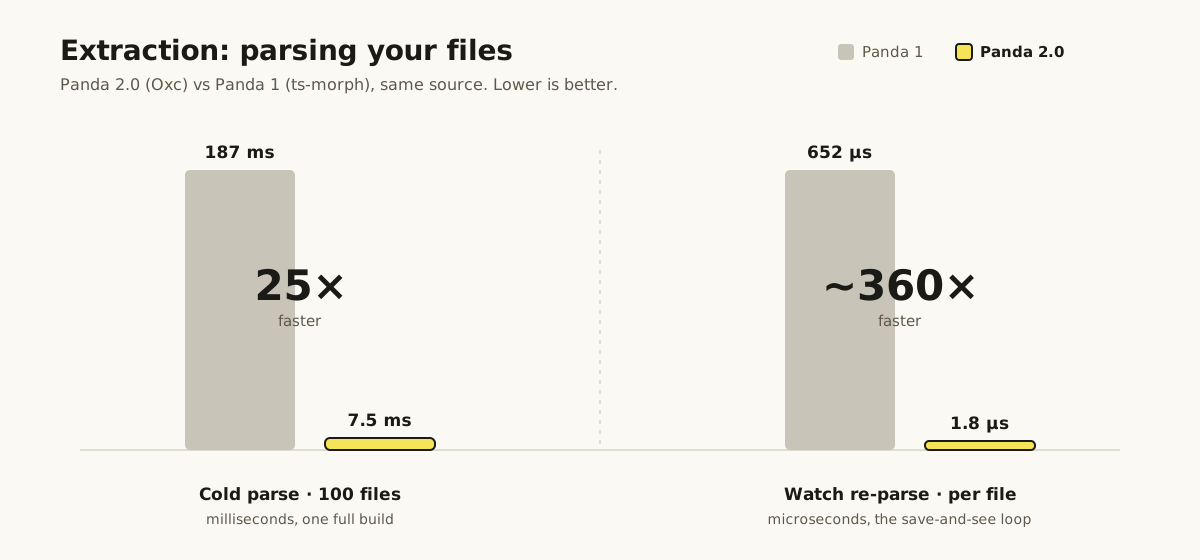
Extraction is the core of what the rewrite replaced: parsing your files and pulling out the styles. Across fixtures from a handful of real files up to a synthetic thousand-file project, the Oxc engine runs a cold extraction 15 to 37 times faster than the ts-morph engine.
| Fixture | Files | Cold-build speedup |
|---|---|---|
| A real Vite + TS sandbox | 5 | 22.6× |
| Synthetic project | 100 | 37.3× |
| Synthetic project | 1000 | 30.3× |
The underlying reason is parser throughput: the old path sustained roughly 1.2 MB/s of TypeScript source, the new one around 37 MB/s — about a 30× gap that holds steady as projects grow.
Watch-mode re-parsing is hundreds of times faster
The number you feel every day is the one for saving a file. When a single file changes, the old engine re-parsed it through the TypeScript compiler; the new engine re-parses it through Oxc. On a steady-state watch, that step went from around 650 microseconds per file to under 2 — roughly 360–390× faster. Real sandboxes bear it out end to end: a Next.js pages project's parse step dropped from 762 ms to 31 ms.
staticCss builds are ~85× faster
staticCss pre-generates a matrix of utilities and recipes, often across breakpoints and containers. It was one of the slowest things you could ask v1 to do, and two long-standing community reports centered on it. On the larger of the two configurations (about 29,000 rules), the numbers now look like this:
| Engine | Build time |
|---|---|
| Panda v1 | 25.7 s |
| Panda 2.0 | ~0.3 s |
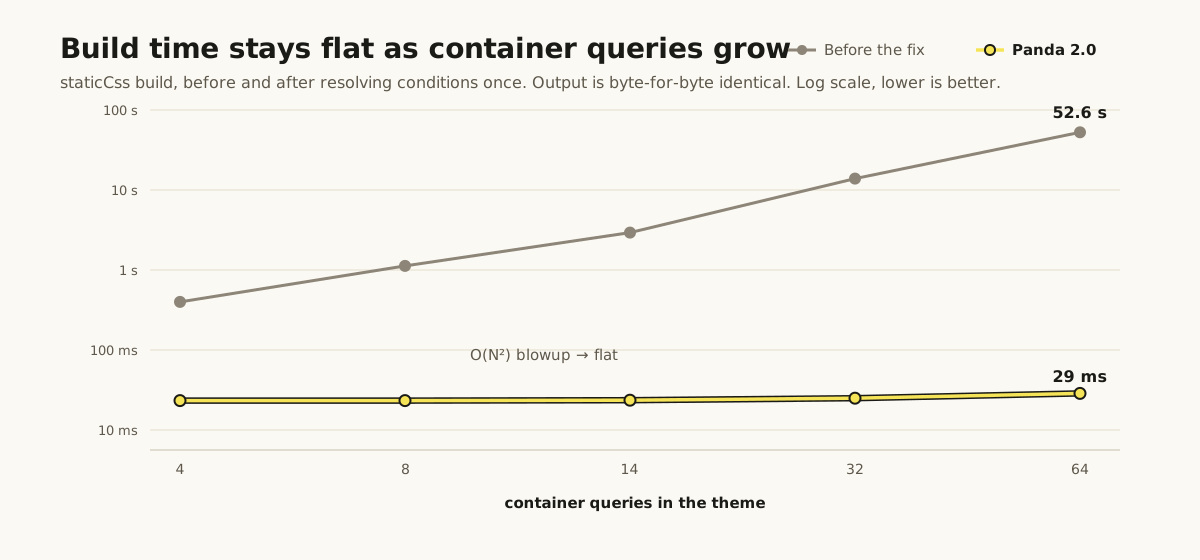
That's roughly 85× faster, and it holds up as you scale the number of container queries — a 64-container configuration that took Panda 52 seconds now finishes in under 40 milliseconds. Part of that is Rust, but part was a genuine algorithmic fix: v2 was briefly resolving condition queries once per rule lookup, which made emit cost grow with the square of the container count. Resolving them a single time up front is what turns the last few seconds into fractions of one, and the CSS it produces is byte-for-byte identical. There's a regression test guarding it so it can't creep back.
Your generated types cost your editor far less
The static-extraction win has a quieter cousin: the TypeScript types Panda generates for your styled-system. v2 emits a leaner type graph built around a single shared conditional-value type instead of thousands of individually instantiated ones. Type-checking the same usage file against the generated types shows:
- ~99% fewer type instantiations — on the order of 20 instead of 2,600
- ~21–25% less memory in
tsc - 40–60% less type-check time
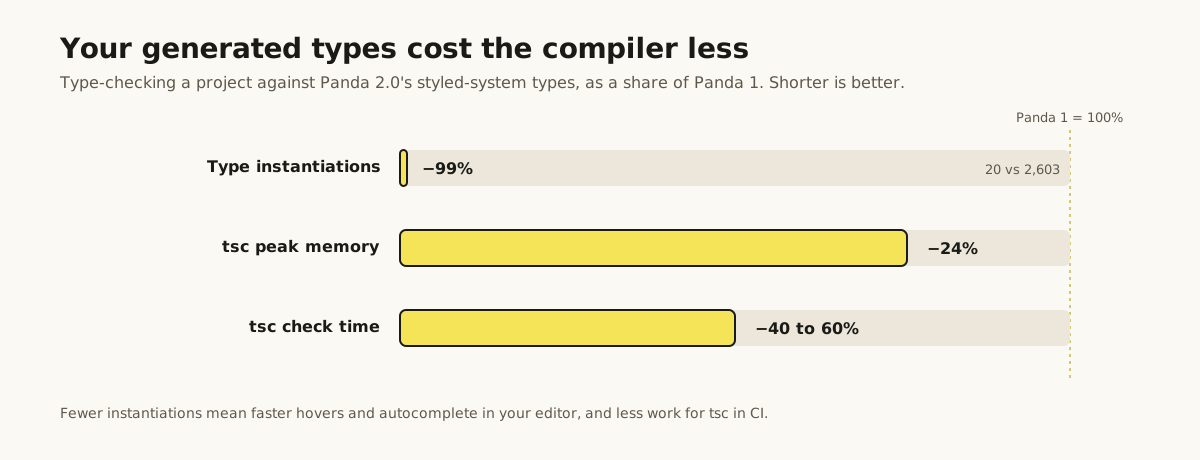
That's a faster editor when you hover a prop, and less work for tsc in CI.
The runtime got faster too
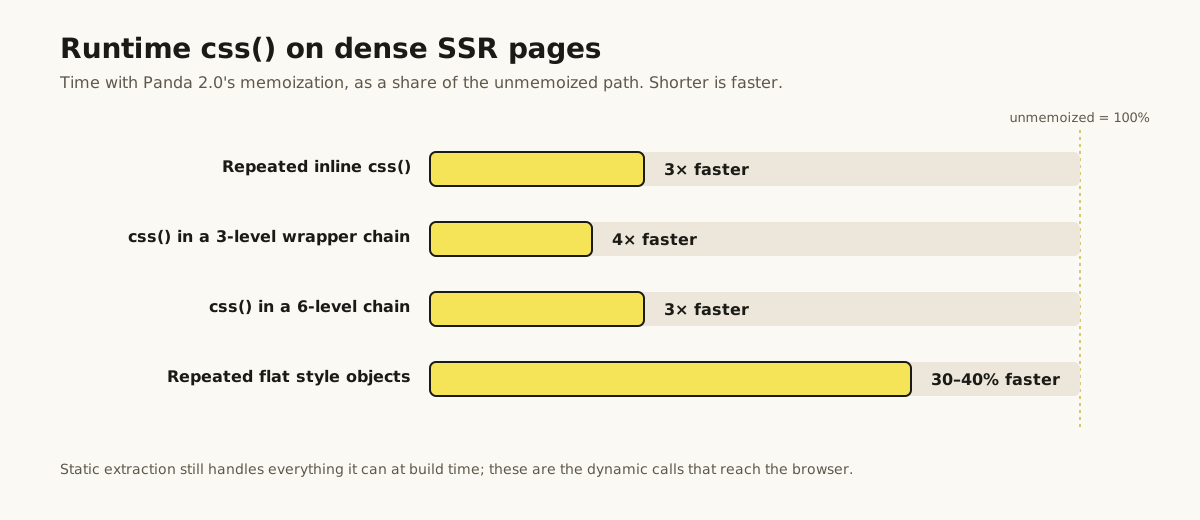
Not all of Panda runs at build time. The css() function and recipe runtimes ship to the browser for the dynamic cases static extraction can't cover, and v2 layers memoization over them. Repeated inline styles on a dense server-rendered page resolve about 3× faster, css() calls composed through wrapper chains about 4×, and repeated flat style objects hit the cache 30–40% faster. If you render a table of a few hundred styled rows on the server, this is the difference you'll see.
What isn't faster yet, and where output differs
Two honest caveats, because a release post that only lists wins isn't much use:
- CSS emit speed and output size aren't a fair comparison yet. v2 emits CSS without a full value-level minifier, so its raw output is currently a bit larger than v1's fully optimized output — not missing rules, just less densely packed. Minification parity is the top roadmap item, and until it lands we're not publishing an emit-speed or bundle-size claim.
- These are single-machine numbers. We haven't run a clean-room comparison against other CSS tools, and we're not going to imply one exists. The comparisons above are v1 versus v2 on the same hardware, which is the honest question for anyone deciding whether to upgrade.
What's new
A faster engine is the headline, but the rewrite also cleared the way for capabilities the old architecture couldn't reach. Here's what shipped alongside it.
Design systems you can publish
This is the big one. A Panda design system is now an npm package that ships components and the Panda config they were built against, and consuming it takes one line.
If you've ever tried to share a Panda-based component library, you know the old shape: the consuming app had to wire up presets, importMap, and include all pointing at the library, and then re-scan the library's source on every build to rediscover styles it had already found once. v2 collapses that.
The library author runs one command:
panda libThat writes a manifest, a preset, and the already-extracted build info into the package, and syncs the package's exports for you. The consumer sets one field:
export default defineConfig({
  designSystem: '@acme/ds',
})
Panda loads the library's theme and recognizes imports from both @acme/ds and the app's local styled-system. The important part: it reuses the styles the library already extracted instead of re-scanning its source. The library extracts itself once, at publish time, and every app that installs it reuses that work.
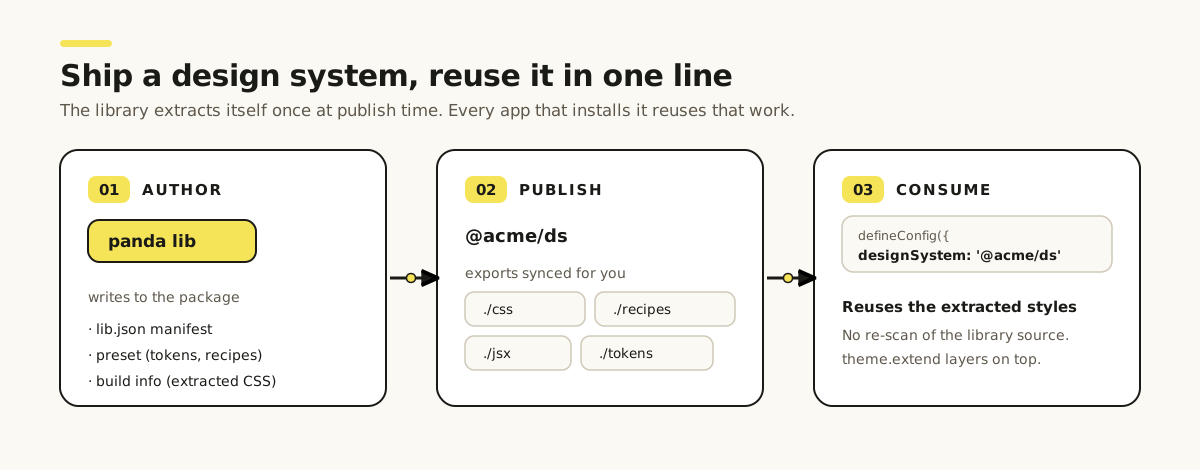
A few things make this pleasant in practice. Your theme.extend layers on top and the app wins on any conflicting token, surfaced as a diagnostic rather than a silent override, so you customize without forking. Resolution works through workspaces, symlinks, and Docker layers because the manifest is resolved as a package export, not by reaching into source paths. Design systems can extend other design systems, and Panda walks the parent chain for you. When something is misconfigured, you get an actionable diagnostic (a stale build info, a missing export, an unsatisfied peer range) instead of mysterious missing styles. There's a dedicated optimize.treeshakeDesignSystem that hydrates only the modules your app actually imports.
View transitions
viewTransition() is a new styled-system function for the View Transitions API. It returns a stable class and emits the matching ::view-transition-* rules for you:
import { viewTransition } from 'styled-system/css'

const slide = viewTransition({
  group: { animationDuration: '0.4s' },
  old: { opacity: 0 },
  new: { opacity: 1 },
})
You can also name reusable transitions in your theme so a preset can share them, and viewTransition('slide') inlines the shared class. Unused named transitions stay out of your CSS.
New utilities in the base preset
The base preset picked up a batch of utilities for things that used to mean hand-writing raw CSS.
Masking — fade an edge or spotlight an image without writing mask-image by hand:
css({ maskBottomFrom: '50%' })
css({ maskRadialFrom: '35%', maskRadialAt: 'center' })
Scrollbars — style each half of the scrollbar as its own property:
css({ scrollbarThumb: 'gray.400', scrollbarTrack: 'gray.100' })Note that scrollbarWidth now takes the CSS keywords auto | thin | none rather than a size token, which is one of the deliberate breaking changes in the upgrade guide below.
More conditions and keywords — pointer conditions (_pointerFine, _pointerCoarse, _anyPointer*), post-interaction validity (_userValid, _userInvalid), the _inert state, every text-wrap keyword including pretty and stable, and two-word alignment values like safe center and first baseline.
Fixed transform axes — rotateX, rotateY, and rotateZ now do what they say, rotate: 'auto' composes them onto transform, and non-uniform scale applies rotation after scaling.
Variables register with @property instead of resetting everything
v1 seeded 34 CSS variables on *, ::before, ::after, ::backdrop so that things like transforms and filters had defaults. That's a lot of declarations on every element whether you used them or not. v2 registers those variables with @property instead, so a variable's default ships only when something actually uses it — and it lives right next to the utility that writes it. Utilities can even declare their own registered variables now.
This needs @property support (Chrome 85+, Safari 16.4+, Firefox 128+). For older engines, optimize.propertyFallback: true also seeds plain-declaration defaults, and there's a native cascade-layer polyfill available through config or --polyfill for browsers without @layer — no PostCSS plugin required.
A rebuilt CLI
The command set got a cleanup and some genuinely new tools. Bare panda runs codegen and CSS generation in one build.
panda doctorrolls up the oldinspect,validate, andinfocommands into one health check. Pass--jsonto consume it in a script.panda analyzereports on your token and style usage as JSON, a static HTML report, or a live report UI.panda debugwrites everything a good bug report needs into a folder you can attach to an issue: platform info, resolved config, per-file extraction, and the project stylesheet.--profileon any command writes a Chrome-tracing / Perfetto profile to.panda/, and unlike v1's--cpu-profit captures the Rust engine's time too.--includeoverrides your configured source globs for a single run, which is handy for scoping a one-off build.panda init -iruns an interactive setup wizard with colored output and next-step hints, and it now scaffolds the base presets by default.
Logging moved to a single --log-level silent|error|warn|info|debug, and startup got lighter — flag parsing no longer loads a schema library on every invocation.
Linting, on the real engine
There's a first-party ESLint plugin with a recommended flat config, and because extraction lives in a shared engine now, the linter reads the same extraction your build does rather than approximating it. The rules cover the mistakes Panda users actually make:
// eslint.config.js
import panda from '@pandacss/eslint-plugin'

export default [panda.configs.recommended]
You get rules like no-invalid-token-paths, no-hardcoded-color via prefer-token, no-shorthand-longhand-mix, no-deprecated, an autofixing consistent-property-style, and an opt-in no-primitive-token that nudges you toward semantic tokens when a matching category exists. The same rules run under oxlint (opens in a new tab) through a dedicated entry point.
A typography preset
@pandacss/preset-typography gives you a prose recipe for styling Markdown or CMS-rendered HTML you don't control, with size variants and semantic color tokens that already handle dark mode:
import typography from '@pandacss/preset-typography'

export default defineConfig({
  presets: [typography()],
})
Extraction that folds more of your code away
Beyond the correctness of extraction, v2 does more to turn dynamic-looking code into static classes:
- Compiled JSX is extracted, not just raw JSX — Panda reads the
jsx()runtime calls that React, Preact, Vue, Solid, and Qwik compile to, socssprops survive the framework's own transform. styledchains fold. A same-filestyled()chain whose class string is constant collapses to the underlying element, so<Button>skips aforwardReflayer at runtime. Chains with variants or dynamic bases keep their runtime behavior.- Static styles survive an unknown spread. A
styled.divthat also spreads unknown props still precomputes everything known at build time into a single class, leaving only the spread for runtime. - Shared classes hoist. A class present in every branch of a conditional is emitted once instead of being repeated across branches.
Codegen and type fixes worth knowing
A handful of type-level changes remove long-standing papercuts. Keyframe names are inlined into the generated types, so css({ animationName: 'spin' }) type-checks under strictTokens without the escape-hatch brackets. Empty token categories no longer collapse to bare string, so native-value autocomplete keeps working. And under strictTokens, native CSS keywords like cursor: 'pointer' are accepted without brackets even when the category is empty.
One rename to be aware of: the built-in CSS value types now carry a Css prefix (CssPosition, CssLength, CssGlobals) so your own {Property}Value aliases can't shadow them. It's in the upgrade checklist below.
MCP and framework plugins moved out
The MCP server is now its own package — run npx -y @pandacss/mcp instead of the old panda mcp subcommand. Vue, Svelte, and Lightning CSS support are available as standalone opt-in plugins (@pandacss/plugin-vue, @pandacss/plugin-svelte, @pandacss/plugin-lightningcss), keeping the core install smaller for projects that don't need them. Source transforms in the Vite, webpack, and Rollup plugins are now opt-in behind transform: true.
Upgrading from v1
Your panda.config.ts carries over. The panda and pandacss binaries are unchanged, panda build still runs codegen and CSS generation in one pass, and the CSS you get out stays in parity — except for a short list of deliberate changes below. Panda 2.0 ships as a beta today; install it with @pandacss/dev@beta. All @pandacss/* packages move on one version, so don't mix a v1 package with a v2 one.
Panda is now ESM-only
v2 needs Node 22 or newer and an ESM project. Set "type": "module" in your package.json and convert any CommonJS config.
// Before
const { defineConfig } = require('@pandacss/dev')
// After
import { defineConfig } from '@pandacss/dev'
Your postcss.config.cjs stays CommonJS on purpose — that's the one file Next.js still expects in CJS, and it keeps working.
Hooks moved to plugins
Root-level hooks moved into plugins, each with a filter and a handler.
// Before
export default defineConfig({
  hooks: { 'cssgen:done': ({ content }) => content },
})
// After
export default defineConfig({
  plugins: [
    {
      name: 'local',
      hooks: { 'parser:before': { filter, handler } },
    },
  ],
})
cssgen:done is observe-only now — you can read the generated CSS but not rewrite the string. The engine-internal hooks (context:created, parser:after, tokens:created, utility:created, and the rest) are gone.
createStyleContext split into two helpers
// Before
const ctx = createStyleContext(recipe)
// After — slot recipe (sva)
const ctx = createSlotRecipeContext(recipe)
// After — single recipe (cva)
const ctx = createRecipeContext(recipe)
There's a new withRootProvider for a slot root that renders no slot of its own.
Config options that were removed
Ten options are gone: studio, eject, emitTokensOnly, gitignore, clean, watch, poll, lightningcss, and browserslist. forceConsistentTypeExtension became forceImportExtension (different semantics, not a rename), and outExtension now also accepts 'ts'.
CLI commands consolidated
panda inspect, panda validate, and panda info are now one command: panda doctor (pass --json for scripts). The --silent / --quiet / --verbose flags became a single --log-level silent|error|warn|info|debug, and --cpu-prof became --profile (which now covers Rust engine time too). Shared flags are kebab-case.
panda ship is gone, replaced by the design-system flow — panda lib to author, designSystem to consume. More on that below.
Internal packages folded into the compiler
If you imported @pandacss/core, /extractor, /generator, /node, /parser, /token-dictionary, /is-valid-prop, /logger, or /reporter directly, drop those imports — they're internal to the compiler now. If you only use @pandacss/dev with Vite or PostCSS, nothing changes. MCP moved to its own package: run npx -y @pandacss/mcp instead of panda mcp.
A few CSS output changes
These are intentional and worth knowing about before you diff your output:
- Border overrides sort by property, not source order. All border shorthands now sit in one tier and all-sides wins. When an override must win, use the longhand —
borderInlineEndWidth: '0'ranks above every shorthand. Padding, margin, and the other directional shorthands sort the same way. - No universal variable reset. v1 seeded 34 declarations on
*, ::before, ::after, ::backdrop. v2 registers them with@property, so they ship only when used. That needs@propertysupport (Chrome 85+, Safari 16.4+, Firefox 128+); setoptimize.propertyFallback: trueto also seed plain-declaration defaults for older browsers. scrollbarWidthtakes keywords now (auto | thin | none), not a token. A singlescrollbarColorvalue moves toscrollbarThumb.
Migrating a large codebase gradually
The one surprise nobody expects is layering. Panda ships its CSS inside @layer, and per the CSS spec, any unlayered rule beats every layered rule, so your legacy, unlayered styles win over converted Panda components by default. If you're migrating incrementally, either run postcss-cascade-layers to strip the layer wrapper (so Panda competes as unlayered too), or hold a clean boundary by route, directory, or team. The migration strategy guide covers this in full.
Try it
npm install @pandacss/dev@betaThe full upgrade guide is in the docs, and the playground (opens in a new tab) now runs the same engine in your browser. We built Panda 2.0 because we wanted a faster, smaller engine we could take everywhere: the CLI, your bundler, and the web. Your code doesn't have to know it happened. That's the point.