Zero runtime, all the way down
Source transforms rewrite css(), patterns, and recipes into class strings at build time. The styling runtime leaves your bundle.

For years, "zero runtime" CSS-in-JS has meant one thing: no styles injected in the browser. The CSS is extracted at build time and shipped as a stylesheet. That part is real, and Panda has done it since day one.
Now look at what still ships. css({ color: 'red.300' }) is a function call. Something has to run it, in the browser,
on every render, to turn that object into c_red.300. Same for hstack(), for button({ variant }), for
<Stack gap="4">. The stylesheet left the runtime. The JavaScript that resolves your styles never did.
Source transforms
Panda removes it with source transforms, a feature of the bundler plugins, @pandacss/vite, @pandacss/webpack,
@pandacss/rollup, and @pandacss/bun. The bundler is the one place that sees your source on its way to the bundle, so
it is the one place that can rewrite it. Turn transforms on and each call site becomes the string Panda already
computed:
// you write
export const title = css({
  fontSize: '2xl',
  fontWeight: 'bold',
  color: 'gray.900',
  _hover: { color: 'blue.500' }
})

// your bundle ships
export const title = 'c_gray.900 fs_2xl fw_bold hover:c_blue.500'
No call. No import. Nothing left to run. It is one flag on the plugin:
vite.config.ts
import pandacss from '@pandacss/vite'

export default defineConfig({
  plugins: [pandacss({ transform: true })]
})
The same flag exists on the webpack, Rollup, and Bun plugins, and the source transforms guide has the full option list. The CLI and PostCSS paths still generate your CSS at build time, but they keep the runtime, because nothing in them rewrites source.
The numbers
A page built from nothing but Panda calls ships 14.3 KB of JavaScript with transforms off, gzipped. With them on, it ships 0.4 KB.
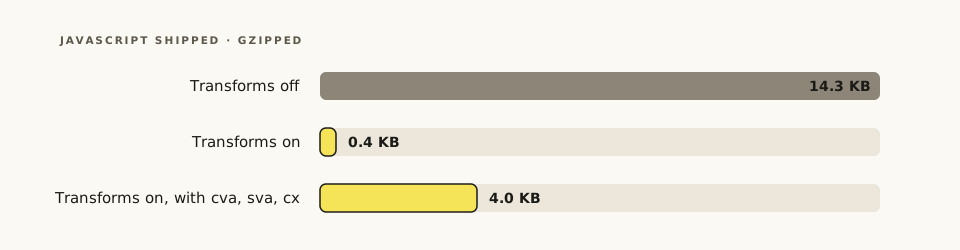
The project is as small as it sounds: a Vite build with no framework and one file. This is the whole source:
src/main.ts
import { css } from '../styled-system/css'
import { center, hstack, stack } from '../styled-system/patterns'
import { button } from '../styled-system/recipes'
import { token } from '../styled-system/tokens'

document.querySelector('#app')!.innerHTML = `
  <main class="${center({ h: 'full', flexDirection: 'column' })}">
    <h1 class="${css({
      fontSize: '2xl',
      fontWeight: 'bold',
      color: 'gray.900',
      _hover: { color: 'blue.500' }
    })}">
      Zero runtime
    </h1>
    <div class="${stack({ gap: '4' })}">
      <section class="${css({
        p: '6',
        rounded: 'xl',
        bg: 'white',
        shadow: 'md',
        borderColor: 'blue.500'
      })}">
        <p class="${css({ color: 'gray.700', lineHeight: 'relaxed' })}">
          All of these class names are computed at build time.
        </p>
      </section>
      <div class="${hstack({ gap: '3', justify: 'flex-end' })}">
        <button class="${button({ variant: 'outline', size: 'sm' })}">Cancel</button>
        <button class="${button({ variant: 'solid' })}">Save</button>
      </div>
    </div>
  </main>
`

document.body.style.setProperty('--brand', token('colors.blue.500'))
And this is the whole bundle it produced, with line breaks added:
document.querySelector('#app').innerHTML = `
  <main class="ai_center d_flex flex-d_column h_full jc_center">
    <h1 class="c_gray.900 fs_2xl fw_bold hover:c_blue.500">
      Zero runtime
    </h1>
    <div class="d_flex flex-d_column gap_4">
      <section class="bg_white bd-c_blue.500 bdr_xl bx-sh_md p_6">
        <p class="c_gray.700 lh_relaxed">
          All of these class names are computed at build time.
        </p>
      </section>
      <div class="ai_center d_flex flex-d_row gap_3 jc_flex-end">
        <button class="button button--size_sm button--variant_outline">Cancel</button>
        <button class="button button--size_md button--variant_solid">Save</button>
      </div>
    </div>
  </main>
`

document.body.style.setProperty('--brand', 'oklch(62.3% 0.214 259.815)')
That is all of it. The 0.4 KB is the app's own markup string. Even token('colors.blue.500') became its value, and not
one byte of Panda shipped. Add cva(), sva(), and cx() to the page and about 4 KB of helpers come back, which is
the third bar. More on those under what stays in the bundle.
In a real app the saving is a fixed cost: the runtime is the same size at nine components or nine hundred.
Why there was a runtime
The CSS was never the problem. Panda has always extracted it at build time and shipped a static stylesheet. The runtime was about class names.
- Panda lets you write styles anywhere. Inline, in a prop, inside a ternary, next to the markup. Extraction could find those styles and write the CSS, but it could not replace the call itself.
- Replacing a call means rewriting your file. That takes a compiler that understands the whole module, sitting in the bundler's path for every file. v1's engine was a TypeScript program in Node, too slow and too far from the bundler to do that.
- So the class-name lookup ran in the browser. The generated
css(), patterns, and recipes shipped as a small runtime whose only job was to map a style object to the class names already in the stylesheet. No styles were computed or injected, just looked up.
The Rust engine already parses each file once, folds constants, and follows values across files. Rewriting the source is that same analysis with a printer on the end.
What ships now
Every example below is the real output of the transformer on the v2 branch. Only the line breaks are ours.
Patterns
A pattern component collapses to the element it renders. The component is gone, the import is gone, and React has one less wrapper to reconcile:
// you write
<Stack gap="4" direction="row">
  {children}
</Stack>

// ships as
<div className="d_flex flex-d_row gap_4">
  {children}
</div>
Recipes
A config recipe call resolves its variants at build time:
// you write
<button className={button({ variant: 'outline', size: 'sm' })}>
  Cancel
</button>

// ships as
<button className="button button--size_sm button--variant_outline">
  Cancel
</button>
Ternaries
A ternary on a runtime value is not a dynamic style. Both branches are known, so both are computed. The browser only picks:
// you write
<div className={css({ p: '4', color: error ? 'red.500' : 'gray.700' })} />

// ships as
<div className={error ? 'c_red.500 p_4' : 'c_gray.700 p_4'} />
Style props
Style props next to a caller-supplied className become a concatenation. No helper, no lookup:
// you write
<panda.div className={props.className} p="6" rounded="xl" bg="white" shadow="md">
  {props.children}
</panda.div>

// ships as
<div className={props.className + ' bg_white bdr_xl bx-sh_md p_6'}>
  {props.children}
</div>
What stays
Unknown values
A value that only exists at runtime keeps its call. This is a decision, not a failure:
// you write
export const box = (color: string) => css({ color, p: '4' })

// ships as
import { cx as __pcx } from '@pandacss-internal/css'

export const box = (color: string) => __pcx('p_4', css({ color }))
Even here, p_4 was computed ahead of time. Only the part that depends on color survives, joined by a cx helper
that knows nothing about your theme.
Runtime variants
An atomic recipe whose variant is chosen at runtime keeps a variant table. The table holds strings, not style objects:
// you write
const button = cva({
  base: { px: '4', py: '2', rounded: 'md' },
  variants: {
    tone: {
      primary: { bg: 'blue.500', color: 'white' },
      ghost: { bg: 'transparent' }
    }
  }
})

// ships as
import { cva as __pcva } from '@pandacss-internal/css'

const button = /* @__PURE__ */ __pcva({
  base: 'bdr_md py_2 px_4',
  variants: {
    tone: {
      primary: 'bg_blue.500 c_white',
      ghost: 'bg_transparent'
    }
  }
})
@pandacss-internal/css is a virtual module the plugin serves. It holds cx, cva, and sva, a file imports only
what it uses, and an unused factory tree-shakes away with its import.
Per call site
One unsafe site never bails a whole file. Here the input spreads unknown props, so it keeps its runtime form. Its parent and sibling are rewritten anyway:
// you write
<panda.div display="flex" gap="2">
  <panda.label fontWeight="medium">{props.label}</panda.label>
  <panda.input {...props.inputProps} p="2" rounded="md" />
</panda.div>

// ships as
<div className="d_flex gap_2">
  <label className="fw_medium">{props.label}</label>
  <panda.input {...props.inputProps} p="2" rounded="md" />
</div>
Panda also only rewrites tags it owns: the factory, its own patterns, and modules you list under importMap.jsx. A
library component that shares a name with a recipe's jsx list still gets its CSS extracted, but its source is never
touched.
How it works
The transform lives in the Rust compiler, next to extraction, and reuses the parse extraction already did:
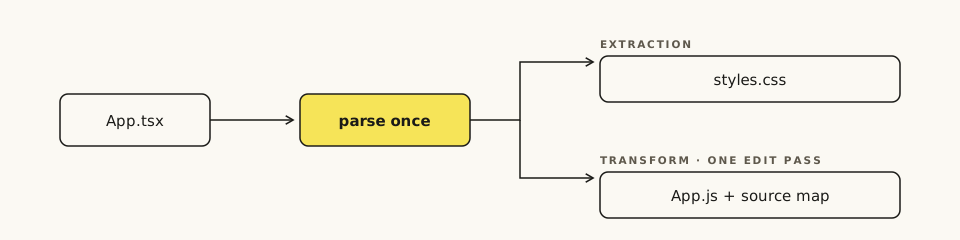
Dead-import cleanup runs on the rewritten text. A fully inlined import disappears. A partly live one narrows:
// you write
import { css, cx } from '../styled-system/css'
export const label = css({ fontWeight: 'medium' })
export const merged = (extra: string) => cx(extra, label)

// ships as
import { cx } from '../styled-system/css'
export const label = 'fw_medium'
export const merged = (extra: string) => cx(extra, label)
The transform lives in Rust, beside extraction, so the same code runs in the native binding and in WebAssembly. The playground rewrites exactly what your build does.
Keep styles static
The transform folds what it can prove at build time. The compiler needs to know the value, not just the shape. Literals fold, and so does a constant in the same file or imported from another. A ternary with literal branches folds to two strings:
// you write
const cardStyle = { p: '6', rounded: 'xl' } as const
export const card = css(cardStyle)

<span className={css({ px: '2', bg: active ? 'green.100' : 'gray.100' })} />

// ships as
export const card = 'bdr_xl p_6'

<span className={active ? 'bg_green.100 px_2' : 'bg_gray.100 px_2'} />
A value built at runtime keeps a call, even when every possible result is a token:
// you write
<span className={css({ px: '2', bg: tone + '.100' })} />
<span className={css({ px: '2', bg: tones[tone] })} />

// ships as
<span className={__pcx('px_2', css({ bg: tone + '.100' }))} />
<span className={__pcx('px_2', css({ bg: tones[tone] }))} />
So, to get the most out of transforms:
- Enumerate, don't compute. A ternary, a
cva()variant, or a config recipe variant folds.tone + '.100'never will. - Pass variant names through props, not style objects.
<Badge tone="ok" />resolves at the call site.<Badge styles={{ bg: 'green.100' }} />forces a runtimecss()insideBadge, and spreading that object keeps the whole call, static keys included. - Reserve runtime
css()for values that are truly unknown. User-picked colors, DOM measurements, API data. That is what the fallback is for, and it still precomputes everything around the unknown value.
The stylesheet left the runtime a long time ago. Now the JavaScript follows it.
pnpm add -D @pandacss/dev@beta